When
I was a child, we celebrated most festivals with as much fervour as we could
muster. But something happened over the years – something that dimmed the light
in our lives. There were financial difficulties, family connections waned,
faith in rituals faltered and a peaceful detachment replaced the sweets and
fireworks of my salad days. But Pepsico’s new campaign ‘Ghar wali Diwali’
inspires me to take a jaunty walk down memory lane. https://www.youtube.com/watch?v=sQ7lMDWJOXA
We
are a Tamilian Brahmin family and if you belong to one too, the memories I’m going
to share might seem quite familiar. Mom would insist on being up at the crack
of dawn, often at 6 AM and having an ‘oil bath’. That entailed oiling the hair
and the body and/or adding a few drops of fragrant sesame oil to the warm
bathwater. I don’t know about the spiritual significance of this practice but it
certainly soothed the senses, eased any random aches and pains and most importantly,
made all of us very hungry for what came next. Oh yes, the Diwali breakfast consisting
of fruits, sweetmeats and carefully prepared savouries was the highlight of the
festival for my eight-year old self. I’ve always had a massive sweet tooth and
relished these treats with all the gusto of an experienced epicurean. There
would be boondi, rawa and besan laddoos, white and brown chaklis and murrukus, coconut
barfis, and sheedes (fried balls of spiced flour). Mom would have been busy
preparing these the previous day, with happy assistance from the rest of the family.
But we could not sit down for this sumptuous feast unless we were dressed in
brand-new clothes. It was auspicious to ring in Diwali in fresh attire, mom
would say. Hence, Diwali clothes shopping would commence up to a month before
the festival.I would invariably pick a
fancy frock or if I was in the mood for ethnic wear, a bright yellow lehenga. Once
we had nourished ourselves, mom and dad would perform a small puja and we would
all thank the deity for blessing us with all that we had. The rest of the day
would be spent burning fuljadis – a noise-free form of pretty fireworks and
then taking a tour of the area post sunset to admire all the pretty lanterns
that people had put up. We put up our own – a bright red star for at least two
weeks after Dipavali. in the evening, we also lit earthen diyas and placed them in the veranda, so that their lovely golden glow would illuminate the world outside, as well as the flames of courage and goodness in our own hearts.
But
when I look around me and see the sheer number of people who are living away
from their families, in their pursuit for a ‘better’ life, I realise how precious
these memories are. And how fortunate I am, that I can recreate them this very
year, with my family here in Mumbai. Thinking about the prospect of spending this
lovely festival all alone makes me want to embrace its full glory once again.
May the lights shine brighter this year. And may there be joy and togetherness
for all those who are reading this.
Are
you assailed by memories and desires of your own after reading my story? Visit https://www.gharwalidiwali.com/ to share your own story
and stand the chance to send a surprise Diwali gift hamper home. Wish you a
very happy Diwali, wherever you are, and in whatever way you may be celebrating
(as long as it’s pollution-free :) ).
It was the fifth time that day that I was going through the settings of my LifeBook. Two hours since I had woken up and the app had not made a single post on my behalf. I had already received five calls from friends and family about my well-being. Panic was starting to set in. Ever since I had been configured in 2045, LifeBook had never failed to record my every moment. Sensors had been implanted at strategic points in my body, supported by an app that sourced data from every area of my life – my words, actions, meetings, feelings, activity on the web and in the offline world. Together, it was a Hyper Intelligent (HI) software that mapped and recorded the user’s life down to the last detail. But today, the app had let me down.
I rode to work in a daze, struggling to remember all the events that had occurred since morning. I wasn’t used to making an effort to recall anything at all. A number? An event in time? The name of a café I’d visited? All I had to do was search my memory archive on LifeBook and it told me what I needed to know. Doctors have raised concerns about possible signs of deterioration of the human memory due to disuse but the makers of LifeBook have successfully refuted every accusation made against the HI software. I had never paid much attention to those reports either. But today, as I faltered while trying to recall what I had eaten for breakfast, I felt a twinge of unease.
When I reached the agency where I sell my skills (writing, research, sketching, voiceovers), my colleague Riya made a beeline for my desk. “I thought you’d dropped off the face of the planet!” I had seven new skill requests in my inbox. Having four different saleable skills helped. I shuddered as I recalled my parents narrate how in their time, everyone sold their skills to one buyer only and that too at the buyer’s terms. Mine was a seller’s world. And I commanded a pretty good price. “Yeah my LifeBook stopped working.” Riya’s eyes widened like saucers. “Are you serious? You do know that the software has never malfunctioned a single time since its launch?” I nodded wearily. I did know. And that was why if I reported it, I was afraid it would take really long to get resolved. “I’m hoping it’ll correct itself without any external intervention. I’m going to give it 24 hours.”
At tea break, all my colleagues (co-freelancers) discussed various items they had seen from the broadcast of each other’s LifeBooks. A dish someone had cooked last night. A broken-down vehicle this morning. A picture of a colleague’s baby. A joke someone had cracked yesterday. A sunrise someone captured today. I felt oddly left out. No one mentioned me at all. I felt stripped of all my consequence. Without my LifeBook, wasn’t I the least bit interesting? I slunk off to have my tea alone on the terrace. There were zero notifications on my phone. Facebook, Twitter, LinkedIn, Google Plus, Instagram, Youtube, SoundCloud, Vimeo, Flickr – LifeBook hadn’t posted anything anywhere. On a normal day, I’d have at least four (non-identical) posts on every one of these websites. That was the frequency I’d set for my LifeBook – one post per platform for every hour. This was the lowest frequency possible. Most opted for at least four posts per hour but I’m a private person. Yet, for the first time in ten years, I felt lonely. I felt like no one cared about me. I felt – insignificant.
“I want you to create a sequel of the ad you wrote for me last month,” Nova Cosmetics, my second buyer for the day told me. My blood ran cold as I realized I had very little recollection of the ad copy I had written. LifeBook’s cloud storage device contained all the work I had created till date. Nobody used offline storage any more. I think my tagline had had something to do with identity but I wasn’t sure. “Would you happen to have a copy of that ad?” I asked hopefully. “We do. We will transfer it to your cloud.” Uh oh. “No, I’d prefer an email.” “Email?!” He sounded incredulous. LifeBook offered unlimited storage and you could send files directly to a certain folder in a person’s cloud. Also, it was synced to your sensors and app data, which made work easier. Nevertheless, I somehow convinced my buyer to send me an old-school email. If word got around that my LifeBook wasn’t working, business would suffer serious damage.
By evening, I was monumentally depressed. All my social media accounts were powered by LifeBook. So, not only was I shut out from the world, the world was also shut to me. I was done with the day’s work and for the first time in years, I contemplated doing something outdoorsy. All recreation was now at our fingertips. Workouts, jogging, walking – everything happened in simulated environments with the perfect air component levels, breeze and designated green components. HI devices allowed us to summon portable screens to watch the films of our choice or surf the Internet. Movie theatres had long since gone out of business. Hardly anyone ventured into the ‘Wild’ anymore – ungoverned, uncontrolled natural territory. But today, I felt like doing something vaguely dangerous. I was without my LifeBook. No one would ever have to know.
From atop a mountain that I had laboriously climbed over the last two hours, I looked down at the city, sparkling like a jewel in the amber glow of the setting sun. I felt weightless, nameless and timeless. There was no LifeBook to take a picture of that stunning view. No LifeBook to post about the sudden stillness in my heart. No LifeBook to record the sound of the wind at this altitude. No LifeBook to remind me this evening ever happened. But I was thankful for one thing – there was no LifeBook to capture the moisture slowly trickling down my face and into the grass, as I lay back to gaze at that stoic, starry night.
I'm the last person who should be writing on happiness. I'm far from the bubbliest, sunniest person you'll meet. But this essay is not about that sort of happiness - the everyday light-heartedness that often masks suppressed dissatisfaction. This essay is about lasting happiness - the kind that should run through your whole life like a leitmotif of contentment.
It's simple really. Figure out what makes you the happiest and then, allow every action you take in life to be influenced by them. Of course, your happiness list will be populated by multiple items. Sort them in order of priority mentally. The most important item should influence your decisions the most, the next most important factor should have a secondary influence and so on. So a list of happiness influencers might look something like this:
1. Being with the one I love the most (partner)
2. Being with the other people I love (family and friends)
3. Writing
4. Travel and nature
5. Financial security
6. Art, music and literature
How do I apply this list? If I go a month without any exposure to art (theatre, art house cinema, classical music), I will be unhappy. However, if I go a month without meeting my partner, my unhappiness quotient will be much, much higher. Therefore, if it comes to a choice between the two, I should prioritise time with my partner, at least four times out of five. The math may not be totally accurate but you get the gist.
On my list, financial security comes fifth while being with the people I love is number one and two. So if I get a fantastic job offer in a city far away from the ones I love, I might be tempted to accept it. But if I do, I won't last more than a few weeks. Because the distance would make me intensely unhappy. Would the sacrifice be worth it in the long run? The answer is debatable but in view of my happiness list, I'd say no.
If you allow your actions to be influenced by anything other than the items on this list, you will be unhappy. One might say - 'why would I do that? It would be totally illogical.' But it happens more often than you would imagine. In fact, it happens all the time. And here's why:
We have only a vague idea of what really makes us happy. If you don't know what exactly you want, you'll never go anywhere in life. That's harder said than done of course. So, conduct an experiment. Maintain a log of the moments during which you were really content and see which ones get repeated the most. Sooner or later, you'll figure out what makes you tick.
We invest more in 'should' than 'want'. I should make my parents proud. I should earn a good salary and work for a respectable company. I should earn more than my peers. I should accomplish the goals I had when I started out. Well at some point, you should start doing what you really want to do. Because all those shoulds are dictated by society, insecurity and sometimes, overly involved well-wishers - none of whom/which are going to contribute to your long-term happiness.
We are taught to be future-oriented. I think I read this in 'The Elephant and the Flea'. We live our whole lives in preparation for an unseen future. It's sad - we toil, save and plan for this time when we will finally allow ourselves to be happy. But before that time comes, often, our time is up in life!
So in a nutshell, learn to recognise what makes you the happiest and every time you make a decision in life, check if it's motivated by one of your happiness influencers. Your happiness quotient will never drop.
(I'm not sure about this but I think the list of happiness influencers varies for men and women and that can cause some dissension. Men (by large) might place financial security higher while women prioritise love. Is this true or am I wrong in my assumption? It would be great if you could comment and let me know what you think.)
We sit in our little nooks The ones we call our own The portions we carved out for ourselves In this almighty world And we look upon the earth Like observers, untouched By wars, riots, famines, tsunamis Only if the roof came crashing down Or the waters swept us out of our nooks Would we realise that We're more than observers Or participants even We ARE the world. Indistinct, in-disparate From a distance, just one big bustling ball From a distance, they wouldn't know That we draw borders And we fight Over You and I Us and Them From a distance, they wouldn't dream Of all the insanity we indulge in And label as - The Way of the World.
Dusty afternoon street That you can almost smell Baked grey by the sun Not that soulful warm cake smell But a dry, lifeless smell The kind that sticks to the soles of your feet And pretends to be tiredness instead When you come home after another day At that place that pays your bills That place that lets you live In this dusty tube-lit flat.
But when it rains - Something happens. Something lyrical, Magical, Sudden. That street - suddenly it smells even better than warm cakes It smells like renewed hope And the vapour of long-held secrets And it makes the feet that tread on it Dance Jump Walk with a spring That's what happens.
And when it rains - That tubelight sputters and gives up Shadows dance across your dusty flat Transformed at once To an elven nook That suddenly sprung up In the midst of this soulless city Cool, wet, green, growing Fresh, moist, new, glowing All that happens.
And the tiredness at the soles of your feet? It has long since lost the battle to rain-soaked mud That squirms its playful way in.
Every one of our lives is a damn good story. And what’s a good story without some twists and turns? If you take up a new job thinking it’s the solution to all your problems, you’re fooling yourself. Your problems will never end – not as long as you’re alive anyway. And that’s the good news. Because problems mean you get to use that wonderful brain of yours. You get to put all those fantastic skills to practise and you get to experience something you haven’t so far. Problems are how you advance – in life, your job and your relationships. Imagine if there wasn’t a single problem in your job for months. How on earth would you prove that you were capable of handling crises? On what basis would anyone ever promote you?
An easy life is for boring people. And generally, life doesn’t allow anyone to remain boring. It gives everyone a really good chance to get interesting. The day you stop expecting life to be easy is the day you decide to embrace the fact that you’re brave, resourceful and open-minded. None of those qualities would mean anything if there wasn’t a crisis or two where they came to the forefront. Enjoy the good times. But wait for the challenging times as well. Keep your metaphorical boxing gloves handy at all times because you never know when you might need them. In fact, get into the habit of predicting possible spokes in your wheel. It can be a really invigorating exercise coming up with possible problems and solutions to them. It gives you confidence because you realise – nothing is so big you can’t handle it. And no problem is so enduring that it lasts forever.
So your favourite boss quit and the new one is a monster in your eyes. So what? Tons of people face that kind of thing every day. Go make an effort to befriend the boss. Understand where they’re coming from and be their ally. If everything fails, talk to your superior. Talk to your HR person. Hell, get a new job. But don’t complain because you had to go through all of that. Everyone goes through things they don’t like or want. But sometimes, the person you are at the end of a crisis is somehow an improved version of the person you were before it.
Don’t fear the downs. Face them head on. Welcome them, even. Without them, your life would be worthy of one big monotonous yawn. And if you think there are folks who don’t have any downs, you’re wrong. Everyone does. The president of the country does. The captain of the world’s best football team does. That’s just how it is. We’re not here to have it easy. We’re here to learn. We’re here to grow. More than anything else, we’re here for an unforgettable adventure.
Expect life to get difficult now and then – though I prefer the term ‘interesting’. And life will never be able to get the better of you. Remember - the only ones with no problems are the ones who aren’t alive.
(This post was originally published at https://www.linkedin.com/today/post/article/20140702165034-47567319-stop-expecting-life-to-be-easy)
How many times have you shaken your head when someone asked you 'What should I do?' and given them an answer you thought was quite obvious? The right thing to do always seems apparent when the choice belongs to someone else. But when it comes to one's own life, the consequences of choices become alarmingly unclear.
But what if you could counsel yourself the same way that you help others out? Wouldn't it help you make faster and more accurate decisions? What if you could always give yourself the right advice without having to ask someone else?
Why it's easier to advise others
You can look at the situation objectively
You have no personal stake in the situation
You are not afraid of the consequences of making the right choice
You are unemotional about the sacrifices that might have to be made in order to opt for the best course of action
You draw from similar experiences in your own past
In our lives, we're constantly confronted by multiple options. And the possibility of missing out on something valuable in the process of taking a decision can be really worrying. There are also times when the complexity of a problem confuses us. We see no way out. But when something like that happens, do this - imagine that it's happening to someone else.
Let's take an example - perhaps, you are currently in a comfortable and reasonably rewarding job and you're only a passive job seeker. Along comes an offer that is everything you once dreamt of. The only catch is - it's at a nascent organisation that has potential but is nowhere close to your current organisation in stature. What should you do? Chances are, you'll be confused. You might feel attached to your current job. The prospect of working in a smaller organisation might scare you. Now, ask yourself what you'd advise a friend in a similar situation. Use this guide to do so:
Perform an objective analysis: List the pros and cons of both choices without being biased. What will you gain and lose in either scenario - if you take up the job and if you don't?
Take a critical look at the consequences: Of the things that you stand to gain and lose, which ones matter the most? Are you willing to compromise on them? More importantly, should you (or your hypothetical friend) be willing to comprise on them?
Put yourself in the future. Five years down the line, would you be comfortable with the choice you made? Do you see yourself making a quick ascent if you take up the new job offer? Or do you see yourself still feeling as rewarded and satisfied as you do now in your current job?
Think about similar crossroads in your own past or in the life of someone you know. Were you confronted with a similar problem in the past? What did you do then and was it the right choice? Or think about stories other people may have told you. There's a lot we can learn from others' experiences, provided we view them in the right context.
Final thoughts
Whether it's a professional or a personal crisis, the amount of information we encounter everyday ensures that we know the right thing to do in most cases. It's more a question of being unafraid and confident enough to follow your own advice. You don't really need confirmation from anyone else, although there is no harm in asking for it.
'Communicate' seems to have become everyone's favourite one-word advice. But truth is, sometimes silence really is the better option. Not the kind of heavy silence that masks grudges and causes further conflict. But rather, the kind of silence that encourages you to move on and not turn every petty disagreement into a major issue.
Communication tends to highlight a problem at hand - in fact, too much of it can create a problem where there was none. This is where it's worth going back to that old adage - choose your battles wisely. There are times when the best of us behave in a manner that may not be worthy of us. Do people have to be punished for every one of these minor faux pas? I think not.
At the workplace, voicing your displeasure too frequently can damage valuable relationships. Communicate when you need to, but don't over-communicate. Reserve the 'clearing the air' sessions for the things that really matter. And remember, in several cases, people are aware when they have rubbed you the wrong way. Chances are, they will rectify their behaviour on their own, without your having to point it out.
Bringing things out in the open magnifies their gravity. It has the potential to put people on the defensive. It can also foster hostility between the people involved.
Cases when communication may not be key:
The problem is a one-off occurrence
The problem has only a short-term impact
The problem can be dealt with actions instead of words
Think about it. Is one missing cc on an email worth a month of stilted conversations and negative synergy? Standing up for yourself is important. But so is keeping the peace.
As a side note, communicating too much can also result in your revealing more than you intended to. The office is not a place to bare your heart, irrespective of consequences. You can always choose to reveal more later - but you can never erase what has already been said/emailed/messaged. Don't withhold key information. But don't lay all your cards on the table at once. Information is power - voice it sparingly. It makes good business sense.
Oman
debunks the myth that the Arab world tends to be removed from the rest of the
world with its numerous efforts to collaborate with Asia, Europe and America.
The
old world character and immense greenery of Muscat are a pleasure to behold.
Perhaps
one of the most attractive aspects of Salalah is that it actually enjoys a
monsoon season!
These are lines from some of the numerous
articles I’ve written on Oman
and its major cities for a newspaper called Global Jobs. Over the years, I’ve
read so much about this Arabian pearl and I’ve marvelled at its unblemished
beauty in photographs. But alas, I’ve had to recreate this country in words
without ever having the privilege of experiencing it for real.
So when I needed information on what to do
and where to go while in Oman,
I had to look no further than my own inbox! Years of research on the living
conditions, culture, weather and business environment in Oman, Muscat
and Salalah lay in front of me. And to supplement that in terms of
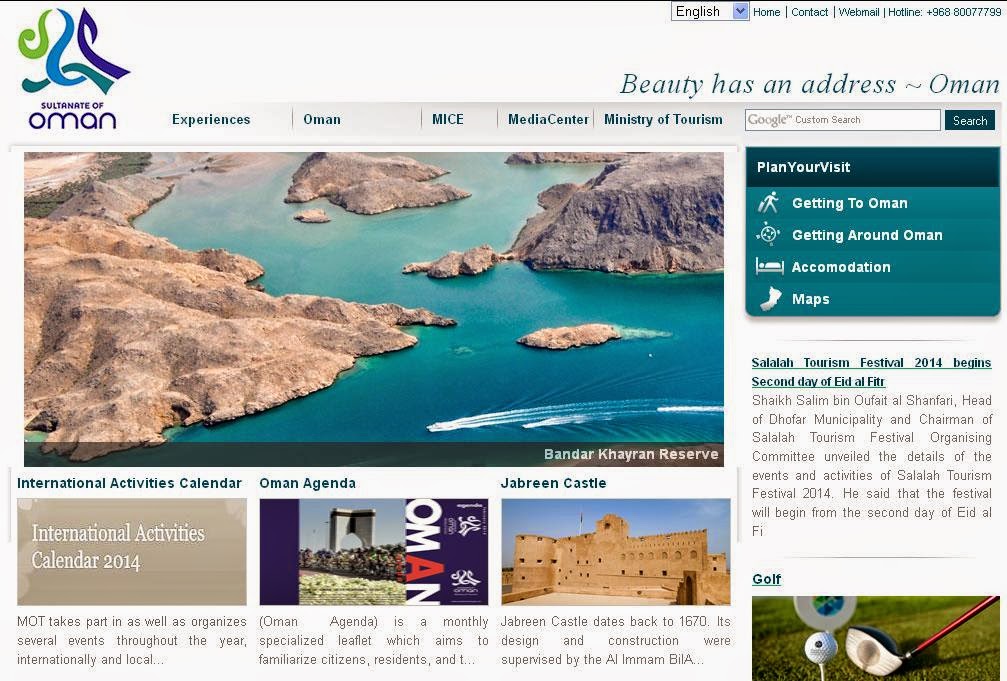
breath-taking images and picturesque descriptions was Oman’s tourism website: http://www.omantourism.gov.om/
When I look at images of JabreenCastle
or the sun-kissed Jabal Shams, I feel as though I’ve known the hypnotic deserts
of Oman
in a previous lifetime. To quote from the Arabian nights:
And I
have regretted the separation of our companionship :: An eon, and tears
flooded my eyes
And I’ve sworn if time brought us back together :: I’ll never utter any
separation with my tongue
I imagine having been an Arabian princess,
swathed in the gorgeous harem pants and blouses that royal women were then wont
to wear. I might have gone for my morning bath at AlKasfah Spring, accompanied
by my merry companions. And then we would have submerged ourselves in its
invigorating warm water and pondered over the deeper questions of life while
gazing into its serene aquamarine depths.
At dusk, I might have sneaked into JabreenCastle for a secret rendezvous with my
Arabian lover. Masked by its majestic turrets, we might have been enthralled by
a belly dancing performance. I would have dreamt of shimmying for an adoring
audience, my pretty sequins reflecting the dancing flames of the campfire.
As a mark of rebellion against my stifling
father who asked me to stop meeting my lover, I might have trekked to Jabal
Shams or the SunMountain. I would have sought refuge in
the An Nakhr balcony, a deep ravine in the heart of the rocks. Surrounded by
these silent, sympathising bastions of time, I would have plotted escape from a
household that dared to shatter my dreams.
To allay the fears of his favourite
daughter, my father the Sultan would have taken me on a trip to Mutrah Corniche
port in Muscat.
We would have picnicked by the sea while he told me the stories behind the ancient
structures that kept us company.
In my dreams, I would fly away on a magic
carpet to the turtle reserve on the beaches extending from Ras Al Hadd to MasirahIsland. I would marvel at the intricate
detailing of the green turtle’s shell. This turtle is a rare species that
returns every year to lay eggs on the same beach where it was born decades ago.
What binds a creature so deeply to its birthplace? And was I bound to Oman in a
similar manner? I would mull over questions such as these while I snacked on
luscious Omani dates and drank Arabian wine.
An assassination attempt on my father! We
would now have to move around with a khanjar, the traditional dagger of Oman, hidden
beneath our robes. Under the guise of participating in a horse race, the favourite
sport of Omanis, we would ride far, far away from our enemies and hide at the
Strait of Hormuz. By day, we would watch the myriad birds at Birds Island and
by night, we would plot ways of extricating ourselves from this torturous
exile.
Our adventures would take us to the Akhwar
(beach lagoons) on whose banks, we would sing traditional Omani songs and recount
tales from the times when the beautiful island of Zanzibar used to be Oman’s
capital. Beneath the lagoon’s tranquil ripples, there lurked many different
kinds of fishes and secret marine denizens. The children in the family would
have a lovely time trying to coax them to the surface.
To pray for the swift defeat of our
enemies, we would pay a visit to the Sultan Qaboos Grand Mosque whose regal corridors
and pristine marble floors would instil a sense of faith in the Almighty. In my
prayers, I would include a line for my abandoned lover who might be languishing
in the sand dunes of Ramlat Tawq, awaiting my return.
Ramlat Tawq would be my lover’s favourite
desert with its endless stretches of undulating dunes and proximity to our
birthplace, Muscat. Unknown to me, he would go on a quest for my favourite
attar (perfume) at the Sohar Handicrafts Souq (market). Ali believes that this
perfume would bring me back to his forlorn arms.
Our reunion would finally happen in the blessed
glades of the As Saleel Nature Park. Here an Arabian gazelle would watch us
shyly while we exchanged promises to be by each other’s side for many different
lifetimes to come. We would write down our vows on parchment and bury it
beneath an acacia tree, holding nature as witness to the solemnity of our love.
If I ever had the pleasure of setting foot
on the history-laden streets of Oman, perhaps the valleys and the flamingos
would speak to me in a language I hadn’t even known I understood. Perhaps, they
would resurrect memories and impressions of bygone eras – times that my memory
was too young to remember but my soul certainly was not. Perhaps, the caves and
the canyons, so far away from the city I call home would bring me to a
different home altogether – the home I had yearned for all along.
Shukran, Indiblogger (http://www.indiblogger.in/topic.php?topic=110)
and the Ministry of Tourism of the Sultanate of Oman, for allowing me the
opportunity to live a fantasy through these words. An actual trip would be the
crystallisation of a dream I have already seen, many times in my sleep.
Today, I'll tell you a story about a story. My last job was quite uninspiring and unfocussed. It left me with a lot of free time on my hand and a lot of unfulfilled ambition as well. No, my ambition had nothing to do with the corporate world. It had little to do with power and positions. What I wanted was to rework my post-graduation project - a novel I had finished in merely 21 days.
I couldn't possibly risk my bosses peering over my shoulder while I typed away on my office computer. No, I had to find a place and a medium where I could write in private - unobserved and unhindered. Back then, I owned a heavy Toshiba laptop with limited battery life. On one occasion, I managed to lug it to office and from there to my favourite cafe at High Street Phoenix - Dolce Vita. I ordered a beer and set to work on my unwieldy laptop. Alas, the battery began to run out in less than an hour. Just when I was getting into a particularly interesting scene in my story, it was time to stop. What's more, the stress of making sure I had it properly packed made me forget my USB wi-fi enabler at my table itself (I only recalled this omission later - so there was no way to get it back). In the coming days, I lost my pace further and the book remained unfinished for a simple reason - I couldn't find the right technology to write it.
Cut to June 2014. I encountered Indiblogger's new update on the ASUS Transformer Book T100. What interested me was that it came with a detachable tablet. Also, the word 'ultraportable' caught my eye. The truth is, most laptops are as unportable as desktop computers thanks to weight and battery issues. But this one promised to be better than that. I clicked on the link that took me to the product page - http://asusindia.co.in/T100/.
The first thing that caught my eye was the limited period offer - 'Buy an ASUS Transformer Book T100 and get a data 16 GB Micro SD class 10 card free'. 'That's just a gimmick to get people interested', I thought inwardly with my customary cynicism for marketing spiels. But then, I happened to watch the product video that unfolded and I found that literally every feature of the ASUS Transformer Book T100 was designed to keep me hooked even while on the move. Take a look:
Stylish and soft touch coating makes it comfortable to hold: No more grazing
my fingers or finding it uncomfortable while the laptop rests on my lap during
long journeys on the bus or train!
Switch instantly from an ultraportable laptop to a highly mobile tablet: So
once I’ve finished writing a chapter and want to take a break from writing, I
can just switch to the tablet and browse through my favourite shopping sites or
play some games while playing some groovy music.
Intel quad-core processor: One of the things that deters me from using
technology while on the move is the speed. With combined devices, often the
speed is compromised but the ASUS Transformer Book T100 promises not to
disappoint!
1366x768 display for sharp, vibrant images: What is technology worth if you
cannot capture an image of something that touches a chord and then share it
instantly with the world at large? And with the ASUS Transformer Book T100, I’d
be able to see pictures on Facebook and Flickr in the best quality possible.
Windows 8.1 with Microsoft Office 2013: What else does a writer need? Truth
be told, most often, it’s work that keeps me hooked to technology while on the
move. And with this super laptop cum tablet, I’ll have no worries about getting
work done!
11 hours battery life when web browsing: The need to check on my latest
purchases, connecting with friends on social media, sharing articles, reading
my favourite ebooks, listening to online radio – all of this keeps me hooked to
technology. But with my old laptop, I could do none of it on the move because
the battery ran out in less than an hour when unplugged! The ASUS Transformer
Book T100 is the perfect solution.
Mobile dock with 19mm travel keys for comfortable typing: No more typing the
wrong word when the train jolts or someone pushes past me. Now I can be assured
of minimal re-edits with the novel that remains unfinished!
USB 3.0 superspeed port: So I’m with a friend in the park and we’re
transferring images from her pendrive to my laptop. Alas, it takes ages to do
it and before we’re done, my laptop runs out of power. This picture could look
quite different with the the ASUS Transformer Book T100!
Dedicated reading mode: I can say goodbye to aching eyes while I read ebooks
on pale light, which hardly matches the experience of reading a real book in
well-lit surroundings. And wait, now with the ASUS Transformer Book T100, I
won’t have to save to buy a Kindle any more!
Still not convinced? Watch the video for yourself here: https://www.youtube.com/watch?v=W7NgPvQZr7A
Having read and heard so much about this seemingly wonderful product, I was
aching to hold it and see what it felt like. Luckily, the rotate button on the
website http://asusindia.co.in/T100/
allowed me to gain a 360-degree view of the laptop cum tablet. I liked the
stylish steel gray colour and the slimness of the device. Here is what it looks
like from the back:
The fact that the device comes with 32GB storage would also keep me hooked
while on the move. After all, there are movies to be watched, songs to be heard
and books to be read! And research material for my novel occupies its own sweet
space too. Frankly, by now, it had begun to feel as though it might be time to
reopen the folder that housed the chapters I had been reworking on. The device
runs on a 2GB ram, which is faster than most phones and tablets. So I could run
multiple programs on it without having the computer slow down. A 1.2 megapixel
camera ensures that if I’ve forgotten my phone at home, I can still record the
important moments of my life while on the move. And I forgot to mention the
best thing. The ASUS Transformer Book T100 is priced at just 32,999 rupees! I
know, it’s quite unbelievable. That’s less than the price of several high-end
phones! And here you don’t just get a product. You get a whole new incredibly
transformed lifestyle. Still don’t get why I’m
so wowed with the ASUS Transformer Book T100? Watch this: (https://www.youtube.com/watch?v=NVFlmlj51Ok)
I can totally imagine being one of the jet-setting folks in the video. Think
about it – this tablet weights just 550 grams! It’s going to feel really,
really light – for lack of an appropriate simile! The video says – stop for
nothing. I wish ASUS had told me that back in 2013 when I was trying to complete
that novel! But maybe just maybe, if I can get my hands on it, that novel will see the light of day after all. As a parting thanks for reading this post, I’ll leave you with yet another
wonderful video of the incredible ASUS Transformer Book T100 (https://www.youtube.com/watch?v=UM1KH3R1IMs)
P.S.: You can find more videos and dope on this product at www.facebook.com/ASUSIndia. This post is a part of the
Indiblogger 'Time to Transform!’ contest (http://www.indiblogger.in/topic.php?topic=109). What keeps you hooked on
to technology even when you're on the move? Is it playing your favourite games,
talking to friends, catching up on some work you love doing? Write a blog post
on the things that you think will keep you hooked to a "Transformed" T100 when you're on the
move. The most creative and original posts win exciting prizes.
Would you ponder so much about the meaning of life if you knew you’d be gone tomorrow? Time is directly proportional to thought, I believe. The more time we believe we have, the more energy we waste on thinking. If you knew you’d be gone tomorrow, all you’d want to do is live. But in the absence of such a pressing deadline, we keep postponing the living and we keep prioritising the mulling. It’s good to mull over things like birds and sunshine and the colour of your tea. But I’m not sure it’s such a good idea to mull over the lack of direction in your relationship or the uninspiring nature of your job. It may not be a good idea to spend precious minutes analysing the defects in your appearance and the faults in your peers. Perhaps philosophising is a purer form of thought. But it’s still not as good as running, singing or loving. It’ll never be as good as baking a cake or eating one. Sometimes when I’m working out, I’ll start to wonder what the point is if my body is going to be ashes one day anyway. Why should I invest so much time in sculpting and perfecting it? The answer is simple. Because in this moment, it feels good. It’s rewarding, exhilarating and it gives me purpose. Even if I were to be gone tomorrow, today would have all the meaning in the world. The future does not lend definition to your present moment. The present lends definition to the present moment.
Friendship was easy when we were in kindergarten - we met those kids everyday - we played, we talked and occasionally, we were invited to each other's homes. We didn't squabble over why we didn't call each other often enough or take offense over innocent remarks. Oh, we might have broken each other's toys or given each other memorable bruises but hey, all was fair in love and war.
I had a lot of friends back then. I still do. But I have no idea if they'll be my friends seven years hence - or for that matter, even seven days hence. Because it seems like no one (including me) makes an effort any more. And when we do, the chances of causing damage seem much higher than getting it right.
Friendship is easiest when you see your friend everyday - perhaps at work, the gym or at college. But when you don't, be prepared to deal with innumerable idiosyncrasies of human behaviour and psychology (yours as well as your friend's). Sometimes you'll be left wondering why they haven't kept in touch and sometimes, you'll be the one giving someone else a sleepless night. Eventually, it becomes less about enjoying good times together and more about treading on eggshells.
It's pretty hilarious how our definition of 'friend' has watered down to something like 'Yeah we hang out together. Sometimes.' It's only the dictionary that seems to believe that a friend is 'a person with whom one has a bond of mutual affection'. I think, our friendships today have become trapped in the notion of being together, physically. The idea of friendships that survive the years, irrespective of distances and time is alien to us. And this is strange because technology actually makes it easier to sustain relationships. Instead, we use technology to reach out to more people and undermine older connections in pursuit of newer ones.
Recently, a study (http://www.dailymail.co.uk/news/article-2534950/We-demote-old-friends-new-ones-arrive-Research-finds-natural-limit-number-people-stay-touch-with.html) showed that when we make new friends, by starting a new job or going to university, we downgrade or even drop old ones. Who makes the cut and who doesn't? Friendship seems to have become a competitive sport and more often than not, I lack the energy to play it.
Relationships are not static. They are continuously being shaped by incidents, words, shared experiences and even seemingly unrelated events in the lives of the people involved. Given this dynamic, ever-evolving and ever-mutating nature of human connections, it would be silly to expect them to remain the same, even decades down the line. But does that mean we abandon the ones that matter or allow them to fall by the wayside, simply because they aren't what we started out with? No. We redefine them.
We may dislike the pre-attached notions and implications that come with labels but labels are inevitable. In your head, you have many different boxes, each with a label like 'Best friends', 'Close friends', 'Life partner', 'Acquaintances', 'Friends at work', 'Favourite cousins' and so on. And as we move through life, we keep populating these boxes. We do, however, have to be open to the possibility of subtracting from and adding to these boxes. We also have to be open to shifting some names from one box to another. Heck, we may even have to create new boxes altogether to accommodate connections that do not fall into any of the existing mental categories.
What I'm trying to say is, people don't have to grow apart. They just need to find new ways to fit into each other's lives. Because relationships matter. They provide joy, security, conversations, adventures and ideas. They help us find our place in the world. And with every closed/failed relationship, there is a memory deficit - a void that could have been avoided if the relationship had been allowed to change shape and accepted in its new form.
Every morning, we wake up as slightly altered versions of ourselves. We also wake up with subtle rearrangements of all the important relationships that we have chosen to cultivate. And that's a good thing. Has the nature of a friendship changed? Find new ways to bond, care and add value to each other's lives. Redefine yourself and your relationships as you go, because that's the only thing that will help you cope with changing circumstances and priorities. Do not sacrifice precious connections at the altar of marriage, job shifts, movement across cities or even countries. Allow them to breathe, transform and evolve. Redefine them everyday if you will, because that's the only way you'll save them.
We're such a messed-up generation. Addicted to our cell phones, going about our lives like dissatisfied robots and never entirely sure whether we're in love with our partners or not. In fact, we may just be the most messed-up generation ever. We don't lead pre-planned lives the way our forefathers did. We wake up everyday to the threat of a world war or the destruction of the planet due to climatic reasons. We don't know where our lives are headed and we are bombarded with so many options everyday that we can never be sure we've made the right choices. We talk to people we've never met; sometimes regularly and we're often not affiliated to any one culture, philosophy or way of life. We are more exposed to ideas, books, music, movies, people and places than ever before - so much that our lives don't make sense to us any more. We have more knowledge at our fingertips than we can handle; yet the answers to questions that truly matter, elude us. We express ourselves constantly; yet we feel there's no one to listen. We're constantly multitasking - on the phone while watching television, texting while reading, listening to music while walking. Our attention is never focussed; we are always fragmented, distracted and removed from the moment. We fear very little and the word 'duty' makes no sense to us. We are free - yet we are bound by our families with their expectations from a time we haven't known and a world that makes constant demands on our time. We want to be moral; yet our rationality permits us to understand immorality. We want to be good; yet material pursuits make monsters out of us. We have resources but we are clueless about how to use them best. We have ideas but we often lack the passion to follow them through. We have to struggle for nothing - and so, nothing means much to us. We live in a world where anything is possible if you have enough money for it. We live in a world where addictions court us every step of our lives. We live in a world where, as a Facebook meme said, free wifi is easier to get than water. We do not have the crutches of religion, marital compulsion, duty or pursuits of honour. The onus of lending meaning and purpose to our lives - it's entirely on us. And the path we choose to achieve that - the sky is the limit, there too. It's exhilarating and frightening at the same time. Because with so much at stake and so much in our hands, the responsibility for both success and failure lies entirely with us. We are a generation who cannot admire a beautiful sight without wanting to capture it for posterity and then sharing it with the world - all within seconds. We are a generation who cannot feel relevant without a virtual alter ego. We are a generation who can go days without speaking to our immediate families but cannot spend more than a few moments without Internet connectivity. We are a generation of contradictions and I have no idea how we are going to extricate ourselves out of this mess.


.png)






.jpg)